
Employee Commute Comparison
Staff Transportation Services vs Public Transport in Dubai
Which works better for employees: a dedicated company shuttle or Dubai’s Metro, public buses and other public transport? The answer depends on staff locations, shift times, workplace access, route density, budget and how much control the company needs over daily arrivals and departures.
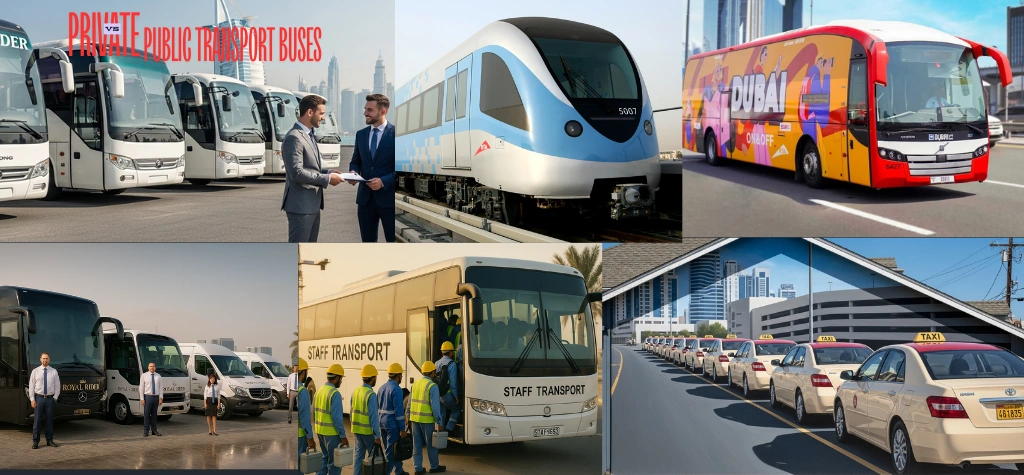
Quick Answer
Is Staff Transportation Better Than Public Transport in Dubai?
Compare Before You Contract
Compare Staff Shuttles and Public Transport
Compare public transport and dedicated employee shuttles by route, shift, cost structure, pickup design, workforce size and operating environment.
Dedicated Employee Mobility
What Are Staff Transportation Services in Dubai?
Staff transportation is a recurring company-arranged service that moves employees between agreed pickup points or accommodation and the workplace. Unlike a one-off private transfer, a staff route normally repeats on defined operating days and is built around reporting times, shift changes and the number of employees travelling on each movement.
The service can use a passenger van for a compact office team, a minibus for a department, a medium bus for a larger shift, or a high-capacity staff bus for workforce movement. The important point is that the vehicle follows an agreed company transport plan rather than a public timetable. That gives the employer more control over where the vehicle starts, which pickup clusters it serves and when it is expected to reach the workplace.
Dedicated transport is not necessarily door-to-door for every employee. For medium and large teams, shared pickup points are often more efficient. A well-designed route balances employee access with realistic travel time; adding every individual home address can turn a short staff shuttle into a long circular route that is difficult to operate consistently.
Existing City Network
How Public Transport Works for Employees in Dubai
Dubai’s public transport network gives employees independent commuting options without requiring the employer to operate a dedicated route. Where an employee lives close to a useful Metro station or bus route and the workplace is also conveniently connected, public transport can be a practical everyday solution.
The key difference is control. Public services operate according to their own network, stops and schedules. The company does not decide the route or departure time. Employees may need to walk to a station, make one or more connections, or complete the last part of the journey by another mode. For many ordinary office commutes that is acceptable; for a fixed industrial shift with dozens of workers reporting together, it may be less convenient.
Public transport should therefore be assessed employee by employee or cluster by cluster. A company should not assume that a workplace located somewhere in Dubai is equally easy to reach from every residential area. The actual origin-to-workplace journey matters more than the general availability of public transport in the city.
Decision Process
7 Steps to Decide Between Public and Dedicated Staff Transport
1
Map Employee Areas
Group employees by residential area or accommodation instead of looking only at the total headcount.
2
Record Every Shift
List reporting and finish times for morning, afternoon, evening and night movements separately.
3
Check Public Connections
Review whether each employee cluster has a practical public route to the workplace at the required time.
4
Identify the Last-Mile Gap
Measure the practical connection between the nearest useful stop or station and the actual workplace entrance.
5
Design Pickup Clusters
If dedicated transport is needed, group nearby employees into sensible common pickup points.
6
Match Vehicle to Each Route
Choose from the normal daily passenger load rather than assigning the same bus size to every route.
7
Compare the Whole Operation
Compare cost, employee access, travel time, route control, shift reliability and administration before deciding.
Side-by-Side Planning
Staff Shuttle vs Public Transport: What Actually Changes?
Route Control
Public: fixed network and stops. Staff shuttle: route can be designed around agreed employee clusters and the workplace.
Departure Timing
Public: employees follow available services. Staff shuttle: planned around company reporting and finish times.
Employee Flexibility
Public: employees can often travel independently at different times. Staff shuttle: employees normally follow the agreed company timetable.
Company Administration
Public: less route management for the employer. Staff shuttle: requires route, passenger and schedule coordination.
Workplace Access
Public: strongest where the workplace is well connected. Staff shuttle: useful for sites that need a direct road-based employee movement.
Shift Operations
Public: suitability depends on service availability at the required time. Staff shuttle: can be planned around recurring shifts subject to the agreed operation.
Public Transport Can Be the Better Fit
When a Company May Not Need a Dedicated Staff Bus
A dedicated staff bus should solve a real commuting problem. If most employees already live near convenient public connections, the workplace is close to a station or bus stop, working hours align well with the network and employees do not need to arrive as one coordinated group, public transport may be the simpler solution.
This can be especially true for smaller office teams with flexible start times. In that situation, contracting a vehicle that runs partially empty may add cost and administration without creating enough operational benefit. Some companies may instead use a mixed model: employees who have easy public access commute independently while a dedicated shuttle serves a location or shift that is difficult to cover.
A fair comparison also recognizes employee preference. Some workers value the flexibility to travel before or after work for personal reasons rather than being tied to a fixed company bus departure. A staff transport plan works best when it reflects the real workforce pattern rather than assuming every employee needs the same commute.
Where Dedicated Routes Add Value
When Staff Transportation Becomes More Practical
Dedicated transport becomes more attractive when a company has a repeated movement that public transport does not serve efficiently. Examples include early or late shifts, factories and warehouses away from convenient stations, staff accommodation with many employees travelling to the same site, or operations where a large team must report within a narrow time window.
It is also useful when the company wants to design a controlled pickup pattern. Instead of asking every employee to build an individual commute, the transport planner can create two or three pickup clusters, assign a vehicle to each route and work backward from the required reporting time. This can make the daily operation easier to supervise.
For businesses already comparing bus rental Dubai options for recurring workforce movement, the important question is not simply how many seats a bus has. The route structure, number of daily trips, shift times and employee distribution determine whether one large bus, several smaller buses or a mixed fleet is the better operating plan.
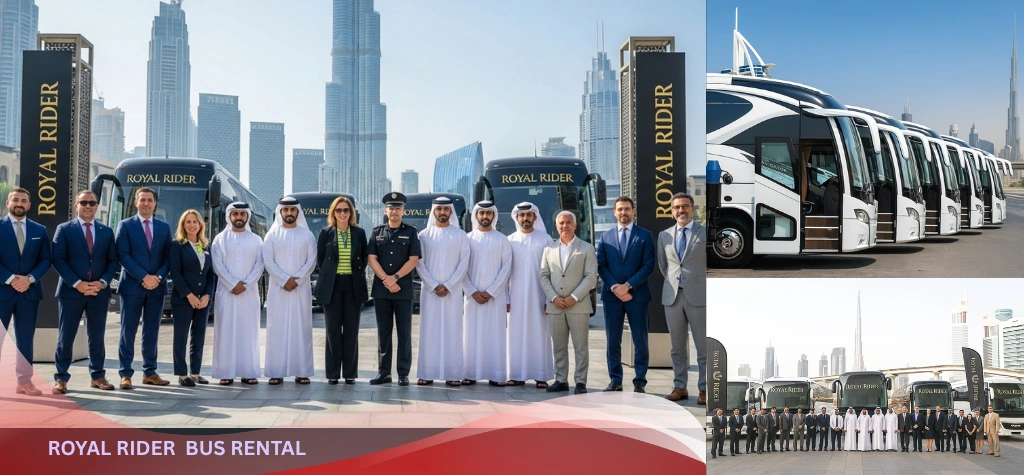
Employee Transport Gallery
Staff Bus Options for Recurring Dubai Routes
Route Design Matters
How to Plan a Staff Shuttle Route in Dubai
Start with the employee map, not the bus. Suppose a company has 50 employees, but they live in four widely separated parts of Dubai. One 50-seat bus is not automatically the most efficient solution because a single vehicle may spend too much time crossing the city before it even starts the main journey to the workplace.
In that situation, two smaller routes can sometimes make more operational sense. Employees can be grouped by geography, each route can have a clear pickup sequence, and both vehicles can work backward from the same reporting time. The opposite can also be true: if 45 workers live in one staff accommodation and travel to one site on the same shift, one larger staff bus may be simpler than several smaller vehicles.
Route planning should include realistic loading time. A route with six pickup points is not only the driving time shown on a map. Each stop adds deceleration, access, boarding and departure time. If a pickup point is difficult for a bus to enter safely or legally, the company may need a nearby common collection point instead.
Shift-Based Operations
Morning, Evening, Night and Multiple-Shift Transport
Morning Shift
Work backward from the required reporting time and allow for employee boarding, traffic and site entry.
Evening Shift
Plan both the inbound and outbound movement, especially when the return occurs after ordinary office commuting hours.
Night Shift
Night routes should be agreed specifically by timing, pickup points, employee count and operating days.
Split Shifts
If different teams report at different times, calculate each movement separately instead of using one combined daily headcount.
Weekend Operations
Confirm which days the route actually operates so the contract reflects the company’s working calendar.
Shift Changes
Where one team finishes as another begins, planners can review whether the same vehicle can serve both movements without creating unrealistic timing.
Choose by Normal Passenger Load
Which Vehicle Fits a Staff Transportation Route?
7–15 Seater Passenger Van
Useful for supervisors, small office teams and compact employee routes where a larger bus would operate with many empty seats.
20–30 Seater Minibus
Suitable for small and medium departments, hotel teams, office groups and shift routes with a consistent mid-size passenger load.
33–35 Seater Bus
A practical middle category for larger staff groups that need more capacity than a minibus without moving directly to a full-size coach.
45–53 Seater Bus or Coach
Useful for larger employee groups, corporate shuttles and recurring movements where the normal passenger count justifies a full-size vehicle.
60–67 Seat-Class Heavy Staff Bus
High-capacity staff and workforce routes may use Ashok Leyland, Tata or another suitable heavy-bus configuration, subject to actual availability and approved seating.
Multiple-Vehicle Route Plan
When employees live in different areas or work different shifts, several smaller routes can be more practical than one long high-capacity circuit.
Compare available vehicles in the fleet, and see staff transportation Dubai for recurring employee routes, pickup planning and shift-based transport.
Pickup Strategy
Fixed Pickup Points vs Door-to-Door Employee Collection
Door-to-door collection sounds convenient, but it can become inefficient as the workforce grows. Ten home pickups spread across a large area may add substantial route time before the vehicle begins travelling toward the workplace. It can also make the schedule vulnerable when one employee is late at an individual stop.
Fixed pickup points create a clearer operating structure. Employees from the same neighborhood can meet at an agreed accessible location, the bus follows a repeatable sequence, and the company can publish a defined departure time for each point. The pickup locations still need to be practical for employees and suitable for the vehicle.
Some operations use a hybrid system. A small number of senior or special-requirement passengers may receive more direct collection while the larger workforce uses common pickup points. The route should be designed from actual operational needs rather than a one-size-fits-all rule.
Different Workplaces, Different Routes
Staff Transport for Offices, Hotels, Factories and Worksites
Office Teams
Office routes may suit smaller vans or minibuses, especially when teams have standard business hours and clustered residential areas.
Hotels & Hospitality
Hospitality staff often work multiple shifts, so separate employee counts and pickup plans may be needed for each movement.
Factories & Warehouses
Industrial staff transport is commonly planned around fixed reporting times, site access and repeated accommodation-to-workplace routes.
Construction & Project Sites
Worker transport can require high-capacity vehicles and strict shift planning. Vehicle suitability and site access should be confirmed before operation.
Retail & Service Teams
Opening and closing shifts can create different transport requirements from a standard office schedule.
Corporate Campuses
Larger organizations may need several route clusters, different vehicle sizes or a central interchange-style pickup plan.
Compare Like With Like
Which Costs More: Staff Transportation or Public Transport?
There is no universal answer. Public transport may have a lower direct commuting cost for employees who already have a convenient route. A dedicated bus creates a company transport cost, but it also provides a controlled route and timetable that public transport does not. Whether that additional control is worth the contract cost depends on the business operation.
Companies should compare the actual staff route rather than using a generic per-person assumption. Dedicated transport pricing can change with vehicle size and type, route distance, operating days, number of daily movements, shift times, pickup points, waiting and contract duration. A 26-day recurring staff route is not simply the same product as a one-day private bus multiplied by 26.
Also compare what is included in each quotation. Driver, fuel, tolls, parking, operating hours, overtime and route changes can affect the final commercial comparison. See how bus rental pricing works in the UAE for quotation factors, and check current rates for private transport estimates.
Operational Controls
What Companies Should Check in a Staff Transport Plan
✔
Suitable Vehicle
Confirm the assigned vehicle size and type, approved seating and suitability for the normal passenger load and route.
✔
Professional Driver
Confirm that the service is operated with the appropriate driver arrangement for the contracted passenger transport.
✔
Realistic Schedule
Allow enough time for pickups, traffic and workplace access instead of building a timetable around ideal driving time.
✔
Clear Passenger List
Keep employee counts current so the route is not routinely overloaded or operated with an unnecessarily large vehicle.
✔
Route Monitoring
Agree how route performance, delays and service issues will be communicated and monitored during the contract.
✔
Contingency Process
Companies should know whom to contact if a route is disrupted, timing changes or an operational issue affects the planned movement.
Avoid Route Problems
Common Staff Transportation Planning Mistakes
✔
Choosing the Bus Before Mapping Employees
Headcount alone does not show how many routes are required or where the vehicle needs to travel.
✔
Too Many Pickup Points
Excessive stops can turn a short commute into a long route and make the timetable harder to maintain.
✔
Using Maximum Headcount Every Day
Select the operation from realistic recurring passenger numbers while allowing for agreed capacity needs.
✔
Ignoring the Return Shift
The morning route is only half the operation; finish times and return pickup patterns also need to be planned.
✔
Assuming Public Transport Is Always Cheaper
Compare the business requirement and employee journey, not only one ticket or one bus quotation.
✔
Assuming a Staff Bus Is Always Better
If employees already have simple public connections and flexible working times, a dedicated route may not add enough value.
A Mixed Model Can Work
Public Transport and Staff Shuttles Do Not Have to Be All-or-Nothing
Some companies can use both systems. Employees in well-connected areas may continue using public transport, while a dedicated shuttle serves a staff accommodation, industrial zone or shift that has a weak public connection. Another option is a feeder-style shuttle between an agreed collection point and the workplace.
This mixed approach can prevent the company from running unnecessary routes while still solving the parts of the commute that create operational difficulty. The decision should be reviewed when the workforce changes, a new site opens, shift times move or employee residential clusters change significantly.
For a recurring service proposal, send the actual route information rather than asking only for “a monthly bus.” See corporate transportation for wider business movements and staff transportation Dubai for recurring employee routes.
Before Requesting a Quote
Staff Transportation Booking Checklist
✔
Employee Count
Give the normal number travelling on each shift, not only the company’s total workforce.
✔
Pickup Areas
List residential areas, staff accommodation or proposed common pickup points.
✔
Workplace
Provide the exact site or destination and any known bus-access instructions.
✔
Shift Times
State required reporting time and finish time for every recurring movement.
✔
Operating Days
Confirm whether the route runs five, six or seven days a week and note any different weekend pattern.
✔
Contract Period
State the intended start date and whether the requirement is temporary, monthly or longer term.
Staff Commute FAQs
Frequently Asked Questions
Answers to common questions about staff buses, public transport, employee pickup points, shifts, monthly routes and vehicle selection in Dubai.
Is staff transportation better than public transport in Dubai?
It depends on the workforce and route. Public transport can be practical when employees live near suitable Metro or bus connections and working hours align with those services. Dedicated staff transport is often more practical for fixed shifts, grouped pickup points, industrial destinations, early or late reporting times, or operations that need one controlled timetable.
When is public transport a good option for employees in Dubai?
Public transport can work well when employees have convenient access to Metro or bus routes, the workplace is easy to reach from those routes, shift times are compatible with available services, and the company does not need to coordinate one shared arrival or departure.
When should a company consider dedicated staff transportation?
A company should consider dedicated transport when employees travel on recurring routes, several workers share the same pickup clusters, the workplace is not conveniently served by public transport, shifts begin or finish at difficult times, or operational punctuality requires a company-planned schedule.
How many employees can travel in a staff bus?
Capacity depends on the assigned vehicle and its approved seating configuration. Royal Rider can arrange smaller vans and minibuses for compact teams, medium buses for larger departments, full-size coaches for bigger groups, and heavy staff buses for high-capacity workforce routes, subject to availability.
What vehicle is suitable for around 20 employees?
A 20–24 seat minibus can be practical for a group of around 20 employees when the approved seating and route requirements fit. If staff carry substantial equipment or the passenger count varies, a larger vehicle may be more suitable.
What vehicle is suitable for around 35 employees?
A 33–35 seat bus can suit a workforce close to that size, but the final vehicle should be selected from the confirmed daily passenger count rather than the maximum possible headcount. Route design and any equipment carried should also be considered.
What vehicle is suitable for around 50 employees?
A full-size 45–53 seat bus or coach may suit a staff group approaching 50 passengers. For recurring workforce transport, Royal Rider may also recommend a heavy staff bus depending on route type, capacity, operating pattern and availability.
Can staff transportation operate for multiple shifts?
Yes. Morning, afternoon, evening and night-shift movements can be planned separately. The company should provide the employee count, reporting time, finish time and pickup pattern for each shift so the route and vehicle requirement can be calculated correctly.
Can a staff bus collect employees from several areas?
Yes, but every additional pickup affects route length and travel time. Efficient staff routes normally group employees into practical pickup clusters instead of creating a long door-to-door circuit across unrelated parts of Dubai.
Is door-to-door employee pickup practical?
It can be practical for a small team or selected executive requirement, but it is often inefficient for a larger workforce. Shared pickup points can reduce detours, make departure times clearer and shorten the total route.
Are fixed pickup points better than home pickup for staff transport?
Often yes for medium and large workforces. Fixed pickup points can simplify route planning and reduce unnecessary detours, but the best arrangement depends on where employees live, shift timing, walking access and the company’s operational requirements.
Can staff buses serve factories, warehouses and industrial areas?
Yes. Recurring employee transport can be planned for factories, warehouses, project locations and industrial workplaces. The route should account for reporting time, site access, shift changes and any restrictions affecting bus pickup or drop-off.
Can staff transportation be arranged for hotels and offices?
Yes. Hotels, offices and other businesses can use scheduled employee transport between staff accommodation, agreed pickup points and the workplace. Different shifts can use different routes or vehicle sizes when necessary.
Can staff transportation be booked monthly?
Yes. Recurring monthly staff transport can be arranged around agreed operating days, routes, shift timings and vehicle requirements. Monthly transport should be quoted from the actual operating plan rather than treated as a multiplied daily rental.
How are staff transportation rates calculated in Dubai?
Rates depend on vehicle size and type, route distance, operating days, number of daily movements, shift timings, waiting requirements, pickup points and contract duration. A recurring staff route is priced differently from a one-off bus transfer.
Does staff transportation include a driver and fuel?
Inclusions depend on the quotation and service package. For an accurate comparison, companies should check exactly what the quoted amount covers, including driver, fuel, tolls, parking, operating hours and any other route-specific charges.
Can companies use route monitoring for staff transportation?
Route monitoring can be part of a company’s transport-control process depending on the operator, vehicle and agreed service. Companies should confirm the available monitoring and reporting arrangements when discussing the contract.
Can dedicated transport help companies manage employee arrival times?
It can give the company more control over planned departure and arrival times because the route is built around the work schedule. Actual travel can still be affected by traffic, incidents, loading delays and other road conditions, so sensible timing margins remain important.
How should a company plan a staff shuttle route?
Start with employee home areas or pickup clusters, workplace location, shift start and finish times, operating days and the number of passengers on each movement. Then compare route options, estimate realistic travel time and choose a vehicle that fits the normal passenger load.
What information is needed for a staff transportation quotation?
Provide the number of employees, pickup areas or proposed pickup points, workplace, shift start and finish times, operating days, required contract period, number of daily trips and any special site-access or vehicle requirements.
Continue Planning
More Employee Transport Information
Need a Dedicated Employee Route?
Send the Staff Count, Pickup Areas and Shift Times
Share the normal employee count for each movement, pickup areas, workplace, reporting and finish times, operating days and contract period. Royal Rider can then review the route structure and suitable vehicle size and type.