
Branded Bus Campaign
Etisalat Smiles App Bus Branding Campaign – Royal Rider
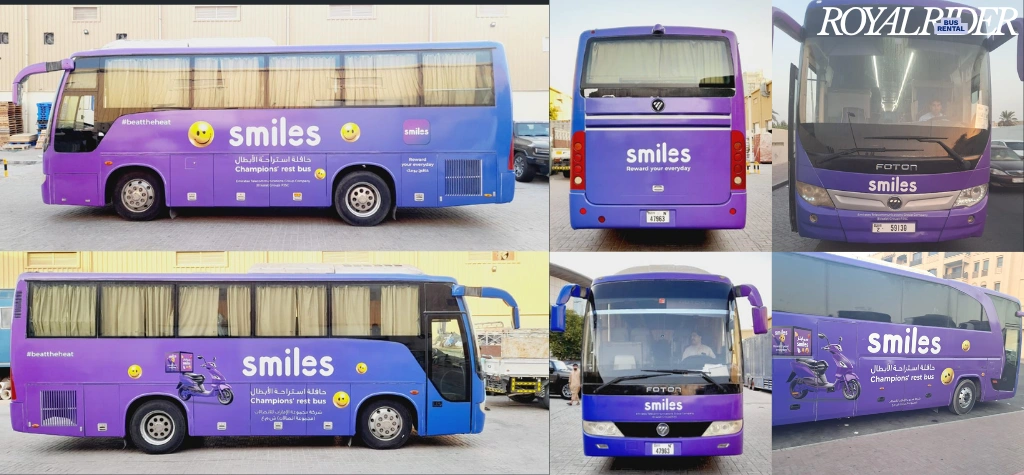
Royal Rider supported the transport operations for an Etisalat Smiles App branded-bus campaign in the UAE. The project combined branded vehicles, driver and fleet coordination, campaign deployment and a practical rider-support requirement in which buses were used as shaded rest points during hot daytime hours.
Quick Answer
What Did Royal Rider Support?
Campaign Operations
From Campaign Brief to Vehicle Operations
See how the transport, branding and activation requirements fit together.
Campaign Overview
A Branded-Bus Activation With an Operational Purpose
The project was not simply a standard passenger transfer. The buses formed part of an on-ground Smiles App activation and needed to work within a campaign schedule while carrying approved branding.
A distinctive part of the brief was rider support. The campaign description called for some branded buses to serve as shaded rest points for motorbike riders during the hotter part of the day. That meant vehicle selection, parking, driver scheduling and location planning had to be considered together rather than treating the buses only as moving advertising surfaces.
The Brief
Two Requirements in One Campaign
Brand Visibility
Vehicles needed suitable exterior space for the Smiles App campaign artwork and an operating plan that matched the activation brief.
Rider Rest Support
Some buses were planned as shaded rest points for motorbike riders between 11 AM and 5 PM, adding a stationary operational requirement to the campaign.
Operational Challenges
What Had to Be Coordinated
A branded vehicle campaign has more moving parts than an ordinary point-to-point bus booking.
Fleet Availability
Suitable buses had to be available for the campaign dates without losing sight of normal transport commitments.
Branding Schedule
Vehicles needed time for artwork fitting, inspection and campaign readiness before deployment.
Approval Coordination
Vehicle advertising can require authority review or permits, so artwork and operating plans should allow for approval lead time.
Driver & Route Planning
Driver hours, vehicle movement, access and the campaign timetable needed to work as one operational plan.
Stationary Locations
Rest-point use introduced parking, access and location suitability considerations beyond normal route movement.
Campaign Close-Out
Unbranding and vehicle inspection had to be planned so vehicles could return to normal fleet use.
Vehicle Planning
Choosing Buses for a Branding Campaign
| Planning Question | Why It Matters |
|---|---|
| Vehicle size | Larger vehicles provide different branding surfaces, passenger capacity and parking requirements. |
| Campaign use | A moving promotional bus, staff shuttle and stationary activation vehicle can require different operating plans. |
| Exterior condition | The wrap provider needs a suitable vehicle surface and enough preparation time. |
| Operating hours | Driver scheduling and campaign deployment should be planned around the actual daily requirement. |
| Location access | Large buses need suitable roads, parking and activation space. |
| Campaign duration | The vehicle must remain available through branding, operation and unbranding periods. |
Royal Rider can assess suitable vehicles once the campaign format, dates and operating requirement are known.
Branding & Wrapping
Artwork, Vehicle Fit and Production Need to Be Planned Together
Bus branding is not only a printing task. The artwork has to suit the actual vehicle dimensions, doors, windows, body panels and any areas restricted by the approval or production process.
The client or appointed agency should provide or approve the campaign artwork. An experienced vehicle-wrap provider can then prepare production files, select appropriate materials and install the branding on the confirmed buses.
Production time should be built into the campaign schedule rather than assuming the buses can be branded immediately before deployment.
Advertising Approvals
Permit and Authority Requirements Must Be Confirmed
Campaign Operations
Deployment Is More Than Choosing a Busy Road
The transport plan should be designed around the campaign brief and legal vehicle operation, not an unsupported promise of impressions.
Daily Schedule
Define reporting time, operating hours, breaks, movement windows and end-of-day requirements for each bus.
Routes & Locations
Choose practical roads and locations that match the campaign objective while respecting vehicle access and operating restrictions.
Driver Coordination
Drivers need clear instructions for reporting points, approved movements, parking and campaign contacts.
Multi-Bus Control
When several vehicles operate together, fleet availability, branding readiness and schedules should be tracked as one project.
Rider Support Element
Branded Buses Used as Shaded Rest Points
The campaign brief described a rider-support element in which branded buses served as shaded rest points for motorbike riders between 11 AM and 5 PM.
That requirement changed the transport planning. A stationary bus needs a suitable location, safe access, parking permission where applicable, driver coverage and a schedule that allows the vehicle to remain available for the activation.
This illustrates why promotional bus projects should be scoped around the actual use of the vehicle rather than treating branding as an add-on to a normal rental.
Campaign Close-Out
Plan Unbranding Before the Campaign Starts
Removal Schedule
Allow time after the final campaign operation for professional wrap removal rather than immediately committing the vehicle to another job.
Vehicle Inspection
Inspect the vehicle condition before branding and again after removal. No universal zero-damage promise should replace a proper material, paint and removal assessment.
Campaign Budget
What Determines Branded Bus Campaign Cost?
| Cost Component | What Can Affect It |
|---|---|
| Bus rental | Vehicle size and type, number of buses, campaign days and operating hours. |
| Driver / operations | Daily schedule, routes, waiting, stationary activation and overtime. |
| Brand production | Artwork coverage, bus dimensions, print material and installation complexity. |
| Approvals | Applicable permit or authority requirements for the campaign. |
| Unbranding | Wrap removal, scheduling and post-removal vehicle inspection. |
| Special activation needs | Parking, rest-point use, event access, reporting or other project-specific requirements. |
Branded-bus campaign pricing depends on the selected vehicles, artwork, dates, operating plan and approval requirements, so a quotation is prepared for the actual project.
What Businesses Can Learn
Practical Lessons From a Branded-Bus Project
✔
Start With the Use Case
Decide whether buses will move, shuttle passengers, park for activation or combine several roles.
✔
Confirm Vehicles Early
Artwork and production depend on the actual bus body and dimensions.
✔
Allow Approval Time
Do not schedule printing and launch as though advertising approval is automatic.
✔
Plan Driver Hours
Campaign schedules must still work within practical vehicle and driver operations.
✔
Define Measurement Separately
If impressions or campaign ROI matter, agree on a measurement method instead of expecting the transport provider to guarantee marketing outcomes.
✔
Include Unbranding
Campaign completion includes professional removal and vehicle return-to-service planning.
Royal Rider’s Role
Transport Operations for Branded-Bus Campaigns
Royal Rider’s role in projects of this type is to make the vehicle operation workable: fleet selection, drivers, scheduling, route and location coordination, campaign-day support and vehicle availability through the agreed period.
Companies planning promotional transport can combine branding requirements with professional bus rental in Dubai operations while keeping artwork approval, advertising measurement and marketing outcomes clearly defined as separate project responsibilities.
Campaign Brief
What to Send for a Branded Bus Quotation
✔
Campaign Dates
Include branding readiness, launch, operating dates and expected close-out date.
✔
Number of Buses
State the required fleet quantity and preferred vehicle sizes.
✔
Branding Coverage
Full wrap, partial branding or another approved treatment.
✔
Operating Plan
Routes, locations, daily hours, shuttle requirements or stationary activation use.
✔
Artwork Status
Tell us whether final artwork exists or still needs vehicle templates and production coordination.
✔
Special Requirements
Parking, event access, reporting, rider rest points or other campaign-specific operations.
Campaign FAQs
Etisalat Smiles App Bus Branding Campaign FAQs
Answers about branded buses, campaign operations, permits, wrapping, unbranding, pricing and promotional vehicle planning.
What was the Etisalat Smiles App bus branding campaign?
It was a branded-bus campaign described by Royal Rider in which buses carried Smiles App campaign graphics and supported an on-ground activation that included transport operations and shaded rest-point use for motorbike riders.
What was Royal Rider’s role in the Smiles App campaign?
Royal Rider’s described scope included supplying suitable buses with drivers, coordinating vehicle operations, supporting branding and unbranding arrangements, planning deployment and helping with the operational requirements of the campaign.
Why were buses used for the Smiles App campaign?
Buses offered a large physical branding surface and could be deployed as part of an on-ground campaign. In this project, some vehicles also supported the rider rest-point requirement.
Were the buses used only as moving advertisements?
No. The campaign description includes both mobile deployment and stationary use, with some buses serving as shaded rest points for motorbike riders during specified daytime hours.
How did the buses support motorbike riders?
The project requirement described buses being positioned as shaded rest points for motorbike riders between 11 AM and 5 PM during hot daytime conditions.
What types of buses can be considered for a branding campaign?
The vehicle should be selected around the campaign objective, branding area, passenger or activation use, parking requirements and route. Mid-size buses and larger coaches can be considered where suitable.
Can a branded bus also be used for corporate transport?
Potentially, yes. A campaign can combine branding with an operational transport requirement when the vehicle, schedule, permits and branding approval support both uses.
Can a branded bus be used as a stationary activation vehicle?
A bus can be planned for stationary activation or rest-point use where the location, access, parking and applicable approvals permit it.
Does bus branding require approval in Dubai?
Advertising and vehicle branding can be subject to authority approvals and campaign-specific requirements. The applicable approval route should be confirmed for the vehicle, artwork, operating area and campaign before deployment.
Does Royal Rider guarantee advertising permit approval?
No. Royal Rider can support operational and permit coordination, but approval decisions remain with the relevant authorities and should not be treated as guaranteed.
Who provides the bus branding artwork?
Campaign artwork is normally supplied or approved by the client or its appointed agency. Final artwork should be checked against vehicle dimensions and applicable approval requirements before production.
Who installs the branding wrap?
Vehicle wrapping should be carried out by an experienced branding or vehicle-wrap provider using materials and methods suitable for the vehicle and campaign conditions.
How is the bus prepared before wrapping?
The vehicle should be inspected and prepared so the wrap provider can work on a clean, suitable surface. The exact preparation process depends on the vehicle and material specification.
Can the wrap be removed after the campaign?
Yes. Unbranding should be planned as part of the campaign schedule and carried out professionally. The vehicle should be inspected before and after removal.
Can Royal Rider guarantee zero paint damage after unbranding?
No universal zero-damage guarantee should be assumed. Material choice, paint condition, installation, campaign duration and professional removal all matter, so the process should be assessed for the actual vehicle.
How long does it take to brand a bus?
There is no universal production time. Artwork readiness, approval, bus size, wrap coverage, printing, installation and inspection all affect the schedule.
How is the cost of a branded bus campaign calculated?
Cost can include vehicle rental, driver and operating time, branding production and installation, unbranding, permits or approvals, parking or activation requirements, campaign duration and the number and type of buses.
Is there a fixed daily price for bus branding in Dubai?
Not for every campaign. A useful quotation needs the vehicle size and type, number of buses, campaign dates, operating hours, branding coverage, route or activation plan and approval requirements.
Can branded buses operate across different UAE emirates?
Multi-emirate operations may be possible, but vehicle operations and advertising permissions should be checked for the actual route and emirates involved rather than assumed to be identical everywhere.
Can Royal Rider plan routes for branded buses?
Royal Rider can plan transport operations around the campaign brief, vehicle access and schedule. Advertising exposure or audience numbers should not be guaranteed solely from a proposed route.
Can a campaign include both moving and parked buses?
Yes, where the operational plan and applicable permissions allow it. This can support campaigns that need transport movement at some times and a stationary activation or rest point at others.
Can branded buses be used for product launches and events?
Yes. Branded buses can be considered for product launches, exhibitions, corporate activations, promotional transport and other campaigns when the vehicle and approval requirements are suitable.
Can the campaign use several buses at the same time?
Yes. Multi-bus campaigns can be planned, but fleet availability, branding production, drivers, parking, operating schedules and approvals should be coordinated together.
Does Royal Rider provide drivers for branded buses?
Royal Rider’s branded-bus transport projects can be planned as vehicle-with-driver operations. Driver schedules and operating hours should be defined in the campaign quotation.
Can GPS or movement reporting be requested?
Operational tracking or movement reporting may be requested where supported by the selected vehicle and project setup. The exact reporting requirement should be agreed before the campaign.
Does Royal Rider promise a specific number of advertising impressions?
No. Audience impressions depend on route, traffic, operating hours, locations and measurement methodology. A transport provider should not promise a specific advertising reach without an agreed measurement system.
Does Royal Rider guarantee app downloads or sales from a branded bus campaign?
No. Royal Rider can deliver the agreed transport and vehicle-branding operation, but downloads, registrations, sales and marketing ROI depend on factors beyond the transport service.
What information is needed for a branded bus campaign quote?
Send the campaign dates, number of buses, preferred vehicle sizes, operating hours, branding coverage, artwork status, planned routes or locations, stationary activation requirements and any special operational needs.
How early should a company plan a branded bus campaign?
Allow time for vehicle selection, artwork preparation, approvals, printing, installation, operational planning and contingency. The required lead time depends on campaign complexity and authority processing.
How can a company start a branded bus campaign with Royal Rider?
Share the campaign brief, dates, vehicle requirement, branding concept, operating plan and locations. Royal Rider can then assess fleet availability and prepare the transport and campaign-operation quotation.
Planning a Branded Bus Campaign?
Send Royal Rider Your Campaign Brief
Share the dates, number of buses, vehicle sizes, branding concept, operating hours, routes or activation locations and any stationary-use requirements.