
Large Group Transport Planning
Large Capacity Transportation Guide UAE
Moving 30, 50, 100 or several hundred passengers is not simply a matter of finding a bus with enough seats. Large-group transportation has to balance passenger numbers, luggage, comfort, pickup points, operating time, vehicle type and the way the group needs to move.
Quick Answer
How Do You Choose Transportation for a Large Group?
Guide Contents
Plan Large-Group Transportation Step by Step
Plan large-group transport by matching the vehicle, passenger count, luggage, route and operating schedule to the actual movement.
Understanding Large-Capacity Transport
What Is Large-Capacity Transportation?
Large-capacity transportation is the organized movement of groups that have moved beyond the practical range of ordinary cars and small passenger vans. Large-capacity planning commonly becomes relevant at roughly 30 passengers and above, including conference delegates, tour groups, airport arrivals, wedding guests, sports teams, staff movements and workforce transportation. The exact threshold is not important; the planning challenge begins when one vehicle, one pickup point or one simple passenger list is no longer enough to manage the group comfortably.
Seat capacity is only the starting number. A 35-seat vehicle carrying 30 passengers with light bags can be a straightforward movement. The same 30 passengers arriving from an international flight with 30 large suitcases, cabin bags and equipment create a different requirement. Likewise, 50 staff travelling from accommodation to a worksite have different priorities from 50 overseas guests travelling between a five-star hotel and an exhibition venue.
The purpose of a large-capacity plan is therefore to match the vehicle type to the job. Compare the complete fleet after the passenger count, luggage, route and schedule requirements are clear.
Large Vehicle Options
Which Large Bus or Coach Fits the Group?
30–35 Seater Bus
A 30–35 seater bus is often practical for medium-large groups that do not need a full-size coach. It can work for corporate teams, wedding guests, local tours, event delegates and point-to-point movements. When the passenger number approaches the full seating capacity, check luggage and equipment before assuming the smallest suitable seat count is the best option.
37–45 Seater Bus
This range gives larger groups more seating flexibility and can bridge the gap between a mid-size bus and a full-size coach. It can suit conferences, group tours, events and larger private movements. The final choice should consider whether the passengers carry substantial baggage and whether the route involves longer travel where comfort becomes more important.
50–53 Seater Luxury Coach
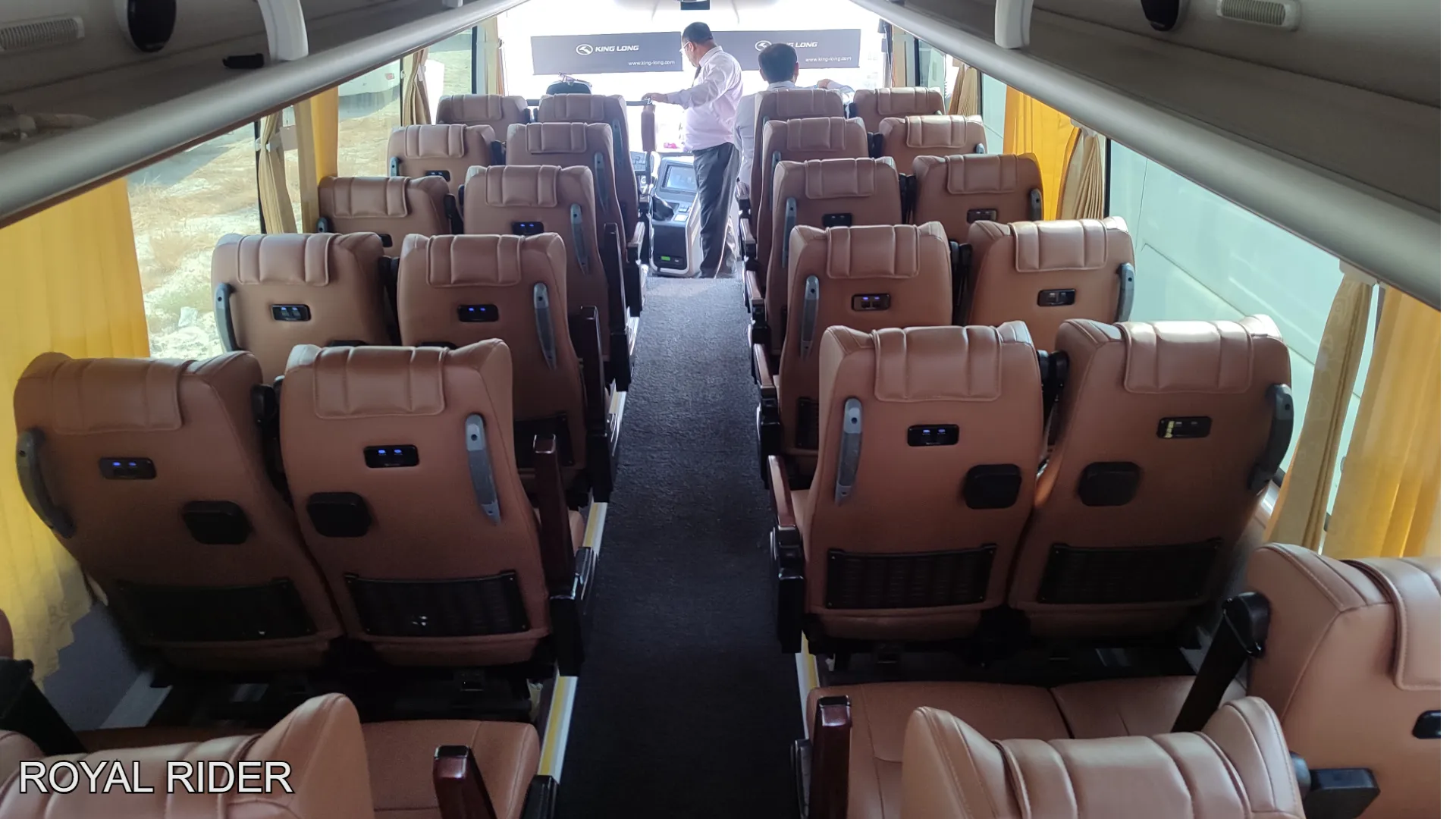
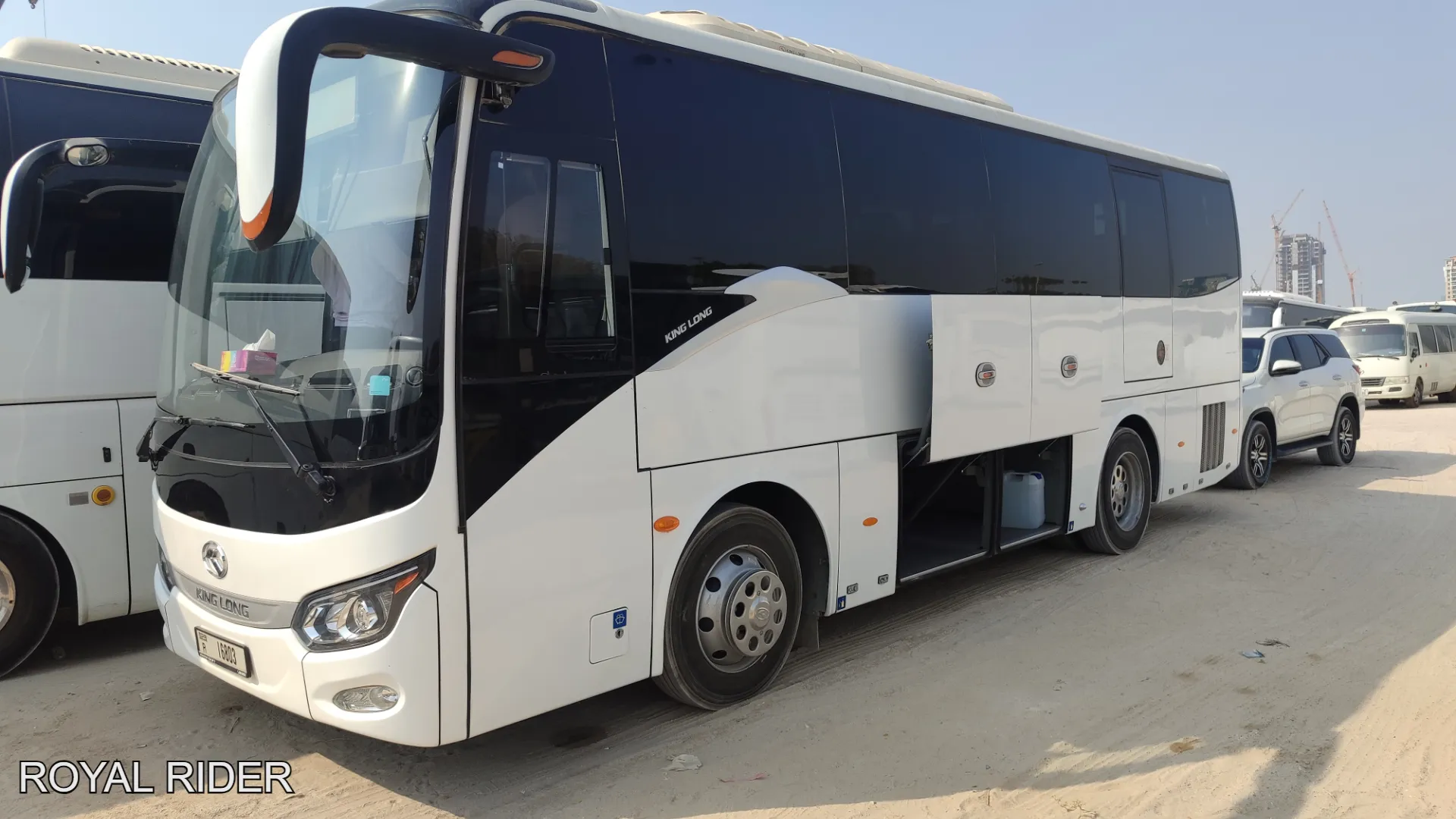
Large touring coaches are commonly selected for big tourism groups, conferences, airport movements, events and inter-emirate travel. Depending on the assigned coach, touring configurations may offer dedicated luggage storage and passenger-comfort features. Actual luggage capacity must still be confirmed rather than inferred from the number of seats.
Heavy Staff & Workforce Bus
Heavy buses are selected around operational passenger movement rather than tourist presentation. They are useful for high-capacity staff routes, labour accommodation movements, shift transport and recurring workforce contracts. Vehicle options can include Ashok Leyland or Tata configurations, subject to availability and the operating requirement.
Large Vehicle Gallery
Large-Group Bus and Coach Planning
Vehicle Comparison
Compare 33, 35, 45, 50 and 53 Seater Vehicles
| Vehicle size & type | Planning role | Luggage consideration | Typical use |
|---|---|---|---|
| 30–33 seater | Medium-large groups | Confirm storage when near full passenger capacity | Events, tours, corporate movements |
| 33–35 seater | Medium-large / larger groups | Check actual configuration and bag count | Tourism, weddings, events, transfers |
| 37–45 seater | Large groups needing more seating flexibility | Dedicated storage varies by vehicle | Conferences, tours, larger group movements |
| 50–53 seater luxury coach | Large touring and passenger groups | Touring configurations may provide larger luggage bays | Airports, tourism, conferences, inter-emirate travel |
| Heavy staff bus | High-capacity operational movement | Selected around workforce requirement rather than tourist luggage | Staff, labour and recurring contract routes |
Important Difference
Luxury Coach vs Heavy Bus: They Are Not the Same Product
Choose by Service Purpose
A luxury coach is normally the stronger choice when the passengers are tourists, corporate delegates, hotel guests, wedding guests or long-distance groups where passenger presentation, comfort and luggage handling are important. Depending on the assigned model, coaches can include touring-oriented seating and dedicated baggage storage that make them better suited to airport and multi-emirate travel.
A heavy bus solves a different problem. Its value is operational capacity for recurring staff and workforce movement: accommodation to workplace, shift changes, industrial routes and longer-term transport contracts. Choosing a heavy bus simply because it has many seats can be the wrong decision for a luxury tourism group; choosing a luxury coach for a repetitive workforce route can also add a level of service the operation does not require.
Large-group transport works best when the vehicle type matches the passenger purpose. Royal Rider’s transport services can be considered together with the available vehicle options instead of selecting a bus from capacity alone.
Fleet Configuration
One Large Coach or Several Smaller Buses?
One large coach is usually easier to coordinate when the entire group starts at the same location, travels at the same time and finishes at the same destination. There is one passenger list, one departure, one driver movement and one arrival to manage. For a 45- or 50-person tour group following a single itinerary, this simplicity can be valuable.
Several smaller vehicles become more useful when the group is operationally divided. A conference may have guests staying at different hotels. An airport group may arrive on three flights. A company may have separate departments finishing at different times. A wedding may need one vehicle for family members and another for guests. In those situations, forcing everyone into one large vehicle can create waiting and unnecessary routing.
The correct question is not “How can we use the fewest buses?” but “How should these passengers actually move?” Once the group is divided into logical movement units, the vehicle sizes become much easier to choose.
Passengers + Bags
Large Passenger Numbers Need Separate Luggage Planning
30 Passengers With Light Bags
A medium-large bus may be practical when the group carries limited baggage and the route is simple. Spare seats can provide operational flexibility, but they do not replace a check of the actual storage arrangement.
40 Passengers With Suitcases
At this level, the luggage count can influence the choice as much as the passenger count. International groups should report large checked bags, cabin bags and oversized items before a coach is confirmed.
50 Passengers With 50 Bags
Do not automatically select a 50-seat vehicle and assume the problem is solved. The assigned make, model, seating layout and luggage-bay dimensions determine what can actually be carried safely and practically.
The bus luggage capacity information explains how to plan suitcases, oversized baggage and vehicle storage without treating nominal seat count as a fixed luggage specification.
Large-Group Use Cases
How Large-Capacity Transport Changes by Service Type
Airport Groups
Airport movements require flight numbers, terminals, passenger manifests and a separate luggage count. Groups arriving on several flights may be better divided into arrival waves rather than keeping the first passengers waiting for the final flight. See group airport transportation for the full planning method.
Corporate Conferences
Conference transport often involves several hotels, fixed venue arrival windows and large return movements after the program ends. Passenger lists should be allocated by hotel or vehicle so coordinators know which guests belong on each bus.
Exhibitions & Events
Large events require more than an outbound trip. Loading zones, event finish times, passenger assembly and return departures all need to be planned. For very large attendance, vehicles can be numbered and assigned to specific passenger groups or hotels.
Sports Teams
A team manifest should include athletes, coaches and support staff, but the equipment list matters just as much. Kit bags, bicycle boxes, golf equipment or event materials can push the group into a larger coach or a separate equipment arrangement.
Weddings & Private Events
Guest transport works best when pickup points and return times are defined in advance. Large buses can reduce the number of private cars arriving at a venue, but late-night returns or different hotel groups may justify more than one vehicle.
Staff & Workforce Routes
Recurring staff transportation is built around shifts, accommodation, workplaces and operating days. For high passenger volumes, heavy buses can be assigned to core routes while smaller vehicles serve locations or shifts with fewer passengers.
UAE Route Planning
Large Groups Travelling Between Emirates
Inter-emirate movements add route distance, operating time, rest considerations, pickup discipline and sometimes multiple stops to the planning process. A large group travelling from Dubai to Abu Dhabi for a conference is operationally different from a local hotel shuttle, even if both use the same coach type.
For a one-way movement, define the exact origin and destination and identify any planned stops. For a return service, provide the expected return time instead of leaving the schedule completely open. Multi-day tours should provide the complete itinerary so the vehicle requirement can be evaluated across the full program.
For customers comparing a large-group journey with other UAE transport requirements, our bus rental Dubai service connects the commercial fleet options with airport, event, tour, staff and inter-emirate movements. Vehicle selection should reflect the passenger count, luggage, route, schedule and the way the group needs to travel.
100–300 Passenger Planning
How Many Buses Do Large Groups Need?
| Group size | Planning approach | What to check before assigning buses |
|---|---|---|
| About 60 passengers | One very large vehicle may not be sufficient; consider two logical passenger groups | Luggage, pickup points, whether everyone travels together |
| About 100 passengers | Often two or more large coaches depending on usable capacity | Final manifest, baggage, coordinators, spare capacity |
| About 150 passengers | Multi-coach operation with passengers allocated by bus | Numbered vehicles, loading area, departure sequence |
| About 200 passengers | Coordinated fleet with defined passenger groups and vehicle leaders | Hotel/flight allocation, staging, route timing, returns |
| About 300 passengers | Event-style transport plan rather than a simple bus booking | Fleet staging, dispatch order, coordinators, backup communication |
Multi-Bus Operations
How to Keep 100+ Passengers Organized
1
Number the Vehicles
Use Bus 1, Bus 2, Bus 3 and so on in the passenger plan so guests and coordinators know exactly where they belong.
2
Allocate Passengers
Divide the manifest by hotel, flight, department, team or tour group rather than allowing passengers to choose buses randomly at departure.
3
Assign Coordinators
Each vehicle should have a responsible group contact who can confirm passengers are present and communicate changes.
4
Plan the Dispatch Order
At busy hotels and venues, every coach may not be able to load at the same curb at once. Establish a staging and departure sequence.
Avoid These Problems
Common Large-Group Transportation Mistakes
Booking Exactly to Seat Count
A 50-person manifest does not automatically make a nominal 50-seater the correct vehicle, particularly when luggage or equipment is involved.
Choosing the Wrong Bus Type
Luxury touring groups and recurring workforce routes have different priorities even when the passenger totals are similar.
No Passenger Allocation
For several buses, random boarding makes headcounts and departure control harder. Allocate passengers before the movement begins.
Ignoring Loading Time
One hundred passengers do not board with luggage as quickly as ten passengers. Build assembly and loading into the schedule.
Unplanned Extra Stops
Several hotels or pickup points can substantially change route timing. Put every planned stop into the itinerary from the start.
No Lead Coordinator
Large operations need a clear customer-side contact who can make decisions and communicate with vehicle coordinators.
Booking Checklist
What to Send for a Large-Capacity Transport Quote
✔
Passenger Count
Give the expected and final number of travellers and explain whether they move together or in separate groups.
✔
Luggage & Equipment
Count checked bags and identify oversized sports, production or exhibition equipment separately.
✔
Route
List the exact pickup, destination and every planned hotel, office, venue or worksite stop.
✔
Schedule
Provide pickup time, required arrival time, return time, service duration and any staggered passenger movements.
✔
Service Type
State whether the requirement is airport, event, tour, corporate, wedding, staff, workforce or another group movement.
✔
Coordinator
Provide the lead contact who will manage passengers and communicate operational changes on the service day.
For current commercial figures, check rates. How Bus Rental Pricing Works UAE explains why vehicle size and type, time, route and operating requirements affect quotations.
Frequently Asked Questions
Large-Capacity Transportation FAQs
Practical answers about 30–53 seat buses, luxury coaches, heavy buses, large airport groups, multi-bus planning and high-capacity staff transportation.
What is large-capacity transportation in the UAE?
Large-capacity transportation is group movement planned around buses and coaches rather than ordinary cars or small vans. In practical terms, it commonly covers groups that need roughly 30 or more passenger seats, although the correct vehicle also depends on luggage, route, comfort level, stops and operating schedule.
What bus size is best for 30 passengers?
A 30-passenger group should not automatically book the smallest vehicle with 30 seats. The practical choice depends on luggage, equipment, desired spare seats and the assigned vehicle configuration. A 30–35 seater bus may work for a light-luggage movement, while a larger coach can be more suitable when baggage or comfort requirements are higher.
What bus size is best for 40 passengers?
A group of around 40 passengers normally needs a large bus or coach with enough usable seats for the final manifest. If the group also carries substantial luggage, the vehicle should be selected around both seating and storage rather than passenger count alone.
Can 50 passengers travel in a 50 seater bus with luggage?
Do not assume that 50 passenger seats automatically provide storage for 50 large suitcases. Luggage capacity varies by make, model, seating configuration and luggage-bay dimensions. For a full passenger load with checked baggage, the luggage requirement should be confirmed before the vehicle is assigned.
What is the difference between a 33 seater and a 50 seater bus?
The main differences are passenger capacity, vehicle dimensions, storage arrangement and the type of movement each configuration suits. A 33-seater can be efficient for medium-large groups, while a 50-seater is more appropriate when the manifest, luggage or operational plan requires greater capacity.
What is the difference between a luxury coach and a heavy staff bus?
A luxury coach is normally selected for passenger comfort, tourism, events, airport groups and longer journeys, while a heavy staff bus is usually selected for operational workforce movement, shift transport and high-capacity contract routes. The correct vehicle type depends on the service purpose, not only the seat count.
Is one large coach better than two minibuses?
One coach can simplify coordination when the entire group follows the same schedule and route. Two smaller vehicles can be more practical when passengers have different pickup points, departure times or destinations. The best arrangement is the one that matches the operating plan rather than simply using the fewest vehicles.
When should I use two buses instead of one?
Two buses are useful when the group exceeds the safe passenger capacity of one vehicle, when luggage or equipment requires more room, or when passengers need separate schedules or routes. Multiple vehicles can also provide operational flexibility for large events and staggered airport movements.
How many buses do I need for 100 passengers?
There is no universal answer because usable capacity depends on the selected vehicles and the luggage requirement. As a planning example, 100 passengers may be divided across two or more large coaches, but the final plan should allow for the actual seat configuration, group leaders, baggage and any need to split the passengers by route or schedule.
How many buses do I need for 200 passengers?
A 200-passenger movement normally requires a coordinated multi-bus plan. The number of vehicles depends on the selected capacities, luggage, pickup points, event schedule and whether all passengers move at the same time. A manifest should be divided into clearly identified vehicle groups before service.
What is the best bus for a large airport group?
The best airport vehicle is one that has enough passenger seats and practical storage for the group’s checked baggage and oversized items. Large touring coaches can be suitable for big airport groups, but the actual luggage count and assigned coach configuration should always be checked.
Can large buses be used for corporate events and exhibitions?
Yes. Large buses and coaches can be planned for conferences, exhibitions, corporate events and delegate movements. The transport schedule should define hotels, venues, passenger waves, loading points, return times and the coordinator responsible for each vehicle.
Are large buses suitable for sports teams?
Yes, but sports teams often carry more equipment than an ordinary passenger group. Athlete numbers, coaching staff, kit bags, bicycles, golf equipment or other oversized items should be counted separately before choosing the vehicle.
Can large buses be used for weddings and private events?
Yes. Large buses can move guests between hotels, residences and venues, particularly when many guests share the same schedule. The booking should include the guest count, pickup points, event timing, waiting requirement and return plan.
What type of bus is suitable for staff and workforce transportation?
The suitable vehicle depends on the number of staff, shift pattern, route, pickup points and required operating standard. Heavy staff buses can be practical for high-capacity workforce routes, while smaller buses may suit departments or shifts with fewer passengers.
Can a 50 or 53 seater coach travel between Emirates?
Large coaches can be planned for inter-emirate group movements subject to the assigned vehicle, route, operating requirements and booking terms. The itinerary should identify the origin, destination, stops, timing and whether the service is one-way, return or part of a longer program.
Does luggage change the bus size I should book?
Yes. A passenger group that travels with large checked baggage may need a different vehicle from a same-sized group carrying only small bags. Passenger capacity and luggage capacity should always be considered separately.
Should I book spare seats for a large group?
Some spare capacity can be useful when the passenger list may change, when coordinators need seats or when the group carries extra cabin items. The amount of spare capacity needed depends on the trip and should not replace proper luggage planning.
How do multiple pickup points affect large-group transportation?
Multiple pickup points add routing, loading and waiting time. For a large movement, each stop should have a passenger count, contact person and planned departure window so the vehicle is not delayed while searching for passengers.
How early should I plan transportation for a large event group?
Large movements should be planned as soon as the event date, approximate passenger count and main route are known. Final flight lists, hotel allocations and passenger manifests can be refined later, but early planning gives more time to coordinate the correct number and type of vehicles.
What information is needed to quote large-capacity transportation?
Provide the date, passenger count, luggage or equipment, pickup location, destination, number of stops, service timing, expected duration and whether the movement is one-way, return, daily or recurring. Event and airport groups should also provide the relevant schedule or flight details.
How should I plan transport for a group staying at several hotels?
Create a hotel allocation showing how many passengers are at each property, then decide whether one vehicle should collect sequentially or whether separate buses should serve different hotels. The decision should consider distance, loading time and the required venue arrival time.
Can large-capacity transport be arranged for daily staff routes?
Yes. Recurring staff transportation is planned differently from a one-off event. The route should define accommodation or pickup points, shift times, worksite or office destination, operating days and the expected passenger volume for each movement.
How do I choose between a 35 seater, 45 seater and 50 seater?
Start with the final passenger manifest, then add luggage, equipment, comfort and route requirements. The smallest vehicle with enough nominal seats is not always the best choice. Compare the actual operating need and assigned configuration before deciding.
Continue Planning
More Large-Group Transport Information
Moving a Large Group?
Send the Passenger Count, Luggage, Route and Schedule
Tell us how many people are travelling, what they are carrying, where they need to go and whether everyone follows the same timetable. The vehicle plan can then be built around the actual movement rather than seat count alone.